
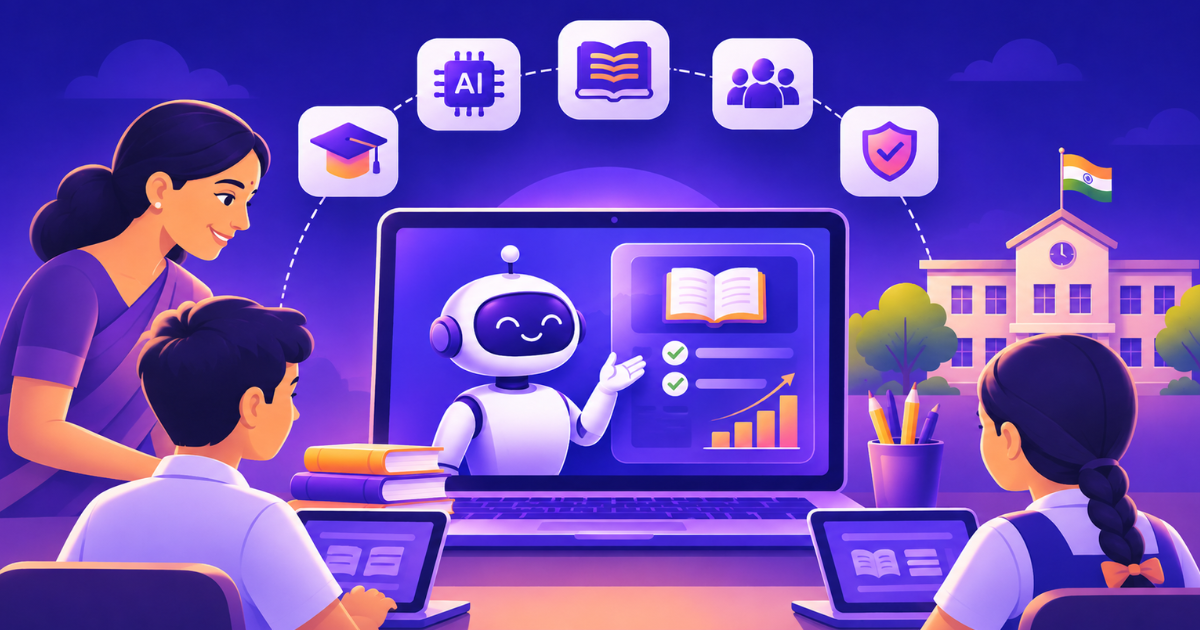
Generative AI has become one of those terms Indian educators hear constantly, but they are never explained clearly. Principals are asked to draft AI policies, teachers are told to use AI responsibly and parents ask what ChatGPT actually is.
Generative AI in education in India is moving into AI and computational thinking that is set to be introduced from Class 3 under the revised National Curriculum Framework, starting the 2026–27 academic year.
This primer is written for that moment. An explanation of what generative AI is, why it matters specifically for Indian schools, where it is already being used in classrooms, what the real risks are and what India-specific guidance schools should be following in 2026.
What Is Generative AI?
Generative Artificial Intelligence creates novel content, such as texts, images, sounds or videos, instead of just analysing existing data and content. Old versions of software programs could only sort out data in a spreadsheet or find a spelling mistake, whereas generative AI can even craft a paragraph, write a test, create a diagram and chat because it was able to learn patterns of text and existing data.
Amongst the tools people use most frequently are ChatGPT and Google Gemini, Microsoft Copilot, and some education-specific software platforms are all examples of products built following the same principle. You give a command (a prompt) to the AI and it generates its own answer from what it has learned from patterns in the data rather than providing a pre-written answer found in a database only.
For a school setting, this version matters more than the technical one. Generative AI in the classroom means a teacher or student is telling what they need and the system produces a draft like a lesson plan, a summary, a practice question or an illustration that a human then reviews, edits and uses. It does not replace judgment; it replaces the blank page.
Why It Matters for Indian Education
Three factors are making it more important rather than a passing trend for Indian schools.
Scale: India has one of the largest school systems in the world, where there is a shortage of teachers compared to student numbers in many states. Tools help in reducing the time that is spent on tasks like lesson drafting, homework creation and basic assessment design. Then teachers can deal with mentoring, discipline, individual attention and classroom management.
Policy direction: With AI and computational thinking, generative AI in schools in India is shifting from an optional teaching aid to something students will be introduced to as part of their coursework. Schools that already use GenAI tools in daily teaching will find it far easier to teach the concept.
Access gap: Most Indian teachers are already using some form of generative AI on personal devices without institutional guidance. That means they are somewhere known with this, but the most important things that are missing are training, curriculum alignment and school-level oversight.
Key Takeaway: This is the reason why our school should use generative AI. It is no longer a question in Indian education in 2026. The real question is how to do it in a structured & accountable manner.
School Use Cases
Generative AI for teachers in India is growing at a consistent pace, with use cases across schools that have started adopting it seriously:
- Lesson planning: A teacher provides a topic, class and duration. Then they receive a structured lesson outline instead of starting from a blank document.
- Homework and assessment generation: MCQs, descriptive questions and worksheets generated directly from a syllabus topic rather than written from scratch for every section a teacher teaches.
- Presentation and content creation: Slide decks, flashcards and summary handouts are generated automatically from a topic or chapter.
- Differentiated learning material: The concept that students are finding it difficult, AI makes it easier with its explanations to a wide range of student abilities within one section.
- Interactive and visual teaching aids: 3D models, simulations and gamified activities for concepts that are hard to convey through text or static diagrams are simple to explain. These are common in science and math classrooms.
- Teacher support and co-piloting: There are conversational AI assistants that teachers can consult for quick clarifications, planning help or classroom-management suggestions during the school day.
Platforms built specifically for Indian classrooms are starting to use cases for this rather than leaving teachers to assemble them from separate tools. NavneetAI helps in making group lessons, homework and presentation generation under its Magic Tools plus an AI Magic Board for pulling existing content into interactive lessons. Even their Magic 3D, Magic Games and Magic Simulation are for the more visual and interactive use cases above all.
Risks and Safeguards
None of the use cases above are risk-free and a credible primer on GenAI education 2026 has to be honest about what can go wrong.
Accuracy risk: Generative AI can produce well-formatted answers that are factually wrong or curriculum-misaligned. It is best to review every output, lesson content, quiz answers and factual claim before it reaches students. It is a basic operating rule for using these tools in a classroom.
Overreliance: If AI-generated content replaces a teacher’s own lesson design entirely, rather than accelerating it, the quality and personal relevance of teaching declines. The solution is to treat AI as a first draft not a finished product.
Data privacy for minors: This is the risk for Indian schools, as any tool that processes student data such as names, performance records and handwriting samples uploaded for grading falls under India’s evolving data protection framework and children’s data carries additional obligations. Thus, schools need to know what data a tool collects, where it is stored and who it is shared with before rolling it out.
Academic integrity: Students using generative AI to produce assignments without disclosure is now a standard concern across Indian schools and colleges. Clear, communicated policies on when and how AI use is acceptable, rather than a blanket ban that’s hard to enforce, tend to work better in practice.
Equity: Not every student has equal access to devices or connectivity outside school. AI-assisted teaching that assumes home access to tools can widen gaps between students rather than close them, unless schools plan around that.
Generative AI in the Indian classroom works best as an assistant a teacher directs and checks, not as an autonomous decision-maker.
India-Specific Guidance
This is the section generally US-centric AI guidance skips and it is the part Indian schools most need to get right in 2026.
Follow the DPDP Act and Rules. The Digital Personal Data Protection Act, 2023 and the DPDP Rules notified by MeitY in 2025 place direct obligations on schools that process student data, including data handled by any AI tool a school uses.
Key points schools should act on now:
Consent for processing a minor’s data should be clearly shown and verifiably obtained. It should not be found within the admission forms. There are legally mandated reporting requirements when a minor’s data is affected. The responsibility to safeguard data rests with the data fiduciary, which is usually the school, and not with an AI vendor. Compliance deadlines are getting closer, but the schools that rely until the final day to comply will inevitably fall behind. Most comprehensive compliance programs take a large portion of the implementation period.
Before adopting any generative AI tool, ask directly:
What student data does it collect? Where is it stored? Is there a data processing agreement with the school and does the vendor have an India-specific privacy stance not a global one written for a different regulatory environment?
Align with curriculum not convenience:
With AI and computational thinking entering the Class 3 curriculum from 2026–27, schools benefit from choosing tools and practices that build AI literacy among both teachers and students.
Training teachers does not only mean deploying tools. Surveys of Indian educators consistently show a gap between how many teachers use AI informally and how many have received any structured training on it. A rollout without training leads to produce risky use. Structured onboarding with certification is not a one-off workshop that closes that gap.
Choose school-level oversight:
A single enthusiastic teacher using AI well does not protect a school from the risks above. Admin-level tracking of which tools are used, by whom and how is what turns generative AI in the classroom from an individual habit into a governed school practice.
FAQs
What is generative AI in one sentence?
It is AI that creates new content like text, images, quizzes and presentations based on an instruction, rather than retrieving a pre-written answer or analyzing existing data.
Is generative AI already being used in Indian classrooms in 2026?
Yes, mostly through individual teachers using general AI chatbots. A growing number of schools adopting purpose-built platforms with structured training and oversight.
Is generative AI safe for use with student data under Indian law?
It can be, but only if the school and the AI vendor comply with the DPDP Act, 2023 and DPDP Rules, 2025, including verifiable consent for minors’ data, breach reporting obligations and a documented data processing agreement between the school and the vendor.
What is the difference between using a general AI chatbot and a purpose-built classroom AI platform?
A general chatbot requires the teacher to supply structure, curriculum, class and format in every prompt and produces a single block of text. A purpose-built platform, like NavneetAI, is designed around the classroom workflow itself, generating lesson plans, homework, quizzes and presentations as ready outputs with training.
Does adopting generative AI mean less teacher involvement in lesson planning?
No, the accurate framing is less time on repetitive drafting, not less teacher judgment. Every credible guidance framework, Indian or global, treats teacher review of AI output as essential, not optional.
1 Comment